Hybrid retrieval
BM25-style lexical search and semantic concept matching recover different kinds of evidence instead of depending on one signal.
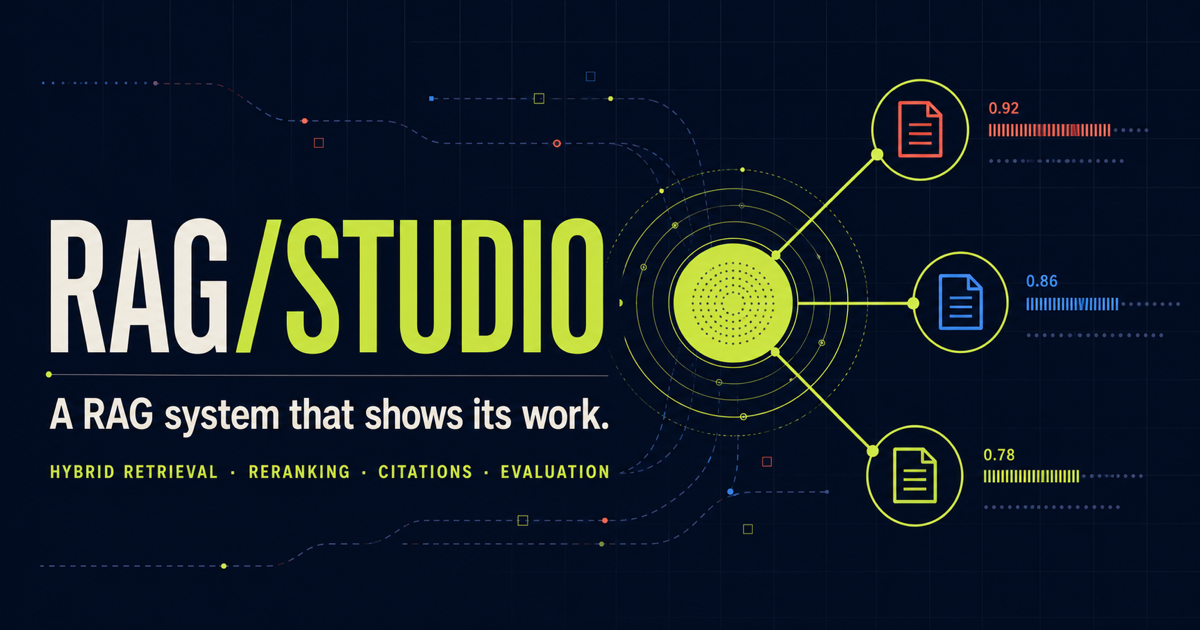
RAG Studio makes retrieval-augmented generation inspectable. It exposes the evidence, scores, latency, citations, confidence gate, and evaluation behind an answer—because a fluent answer is not the same as a trustworthy one.
 LIVE WORKBENCH ↗
The system combines complementary retrieval signals, ranks evidence deliberately, then makes “do not answer” a valid outcome when grounding is weak.
BM25-style lexical search and semantic concept matching recover different kinds of evidence instead of depending on one signal.
RRF combines ranked lists without pretending incomparable raw scores share the same scale.
Candidates are reordered using relevance, query coverage, title affinity, and freshness before context assembly.
Claims stay connected to source excerpts, making support visible to the reader and measurable by the system.
Weak evidence produces a transparent refusal instead of a confident answer assembled from irrelevant context.
Query rewrite, candidates, component scores, context tokens, and per-stage latency turn debugging into specific action.
The complete project walkthrough is hosted with the portfolio. Press play to follow query rewrite, hybrid retrieval, reranking, citations, traces, and evaluation.
No autoplay. Playback begins only when you choose it.
Download MP4 · 3.8 MB ↓The latest checked-in report runs a deterministic 12-query golden set. It includes in-domain retrieval questions and out-of-domain prompts that should abstain.
Open the raw evaluation report ↗Honest read: recall, citation coverage, and abstention are strong in the current set. Precision@4 at 0.521 exposes useful headroom in candidate filtering and reranking rather than hiding it behind a polished demo.
The hosted demo deliberately avoids paid model keys. That keeps behavior deterministic, repeatable, and open to inspection while preserving clear seams for production infrastructure.
Measure lift against added delay; architecture should serve retrieval quality, not decoration.
Heading preservation and overlap affect whether evidence is understandable after retrieval.
A bounded “I do not have enough evidence” is safer and more useful than unsupported confidence.
The implementation, architecture, API contract, evaluation design, executable report, live workbench, and walkthrough are public.